Tuesday, December 19

Noorul Huda

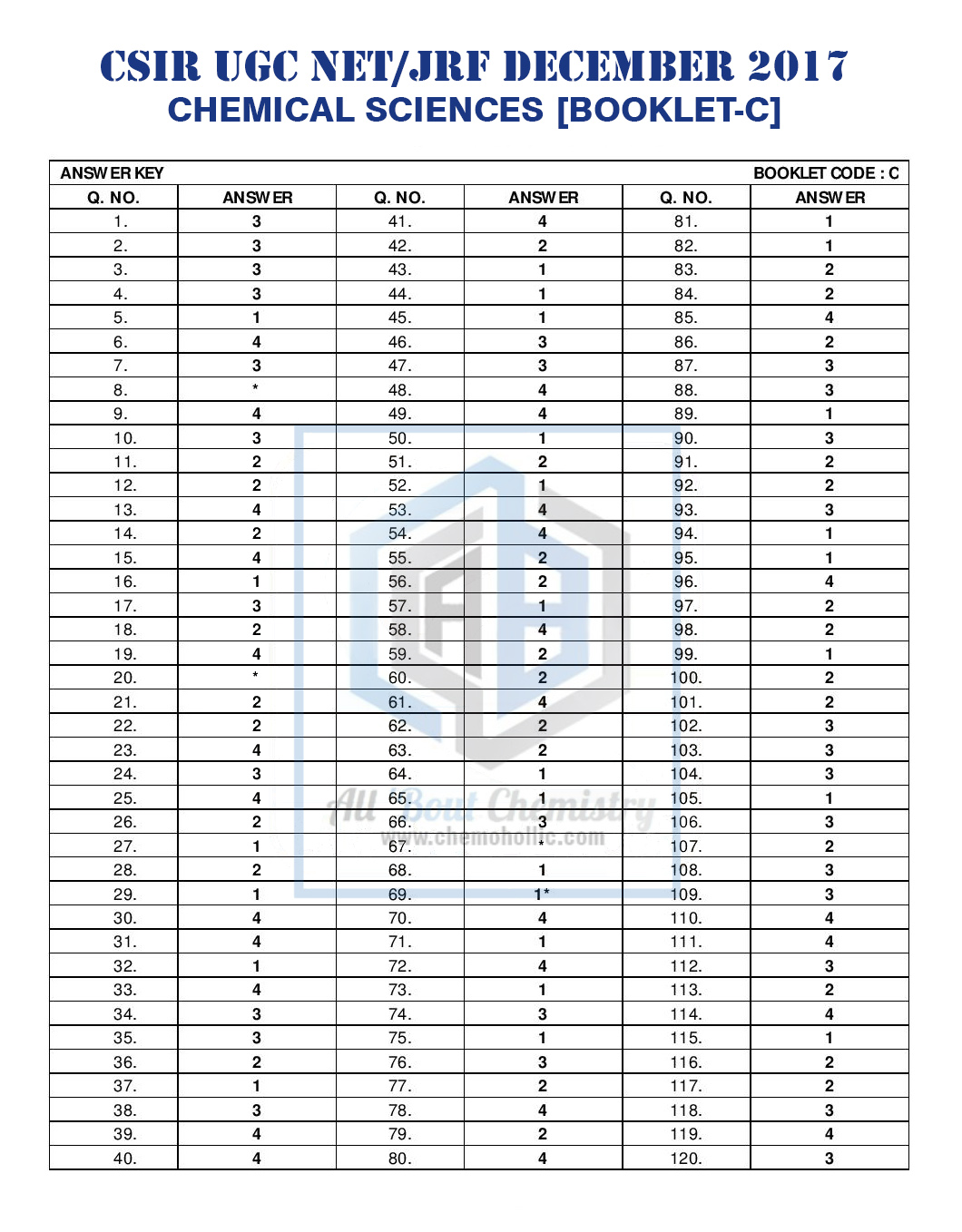
CSIR NET Dec 2017 Question Paper and Expected Answer Key


We are posting CSIR December 2017 Question Paper in this post. Here we are providing Booklet-A. The CSIR Question Papers comes in a three booklet sets namely A, B and C among which all questions are same, just their orientations are different.
The Question Paper consists of total 120 Questions, among which 20 are in Section A, 40 in section B and rest 60 in section C of Question Paper.
For more details about Question Paper, Read Here: CSIR NEW EXAM PATTERN

You Must also Like: CSIR NET DEC 2017 Part-A Answer Key
 
In the below post the complete Question Paper is attached, You can view and download it easily.This post will be helpful for those who didn't gave the Examination or to those who lost their Question Paper. The Paper is scanned and text quality is kept best as could be.


We are continuously trying to help and provide Question Papers, Study Materials, Assignments, Solved Papers and much more. We thank all our visitors for liking our posts and encouraging us to do more.   

You can also download CSIR Previous 10 Years Question Papers and Answer Keys: CSIR NET PREVIOUS YEARS QUESTION PAPERS AND ANSWER KEYS


The Expected Answer Key of Questions is given below:


NOTE: We are not responsible for any discrepancy (if arises) in the answer key, which has been published.


You can show your Love for us by Liking Our Facebook Page and Subscribing to our YouTube channel.
www.facebook.com/chemohollic

and
https://www.youtube.com/channel/UCD9sjzPA93mxDmbL25qYLow?sub_confirmation=1
Read More

Monday, December 18

Noorul Huda

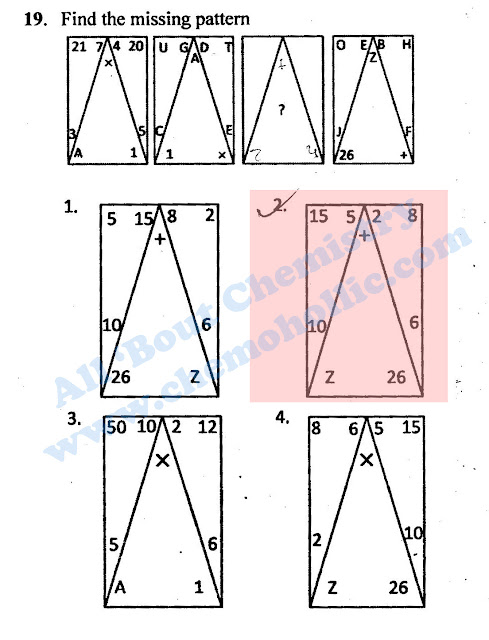
CSIR NET DECEMBER 2017 Answer Key (Part-A)

Hello everyone, The CSIR December 2017 Exams are over and we hope that you all have done well. Talking about the exam, the Questions this time were a bit directly asked as compared to previous years, specially the Physical Chemistry portion. Part-B was a bit more confusing as compared to Part-C.

Lets discuss about Part-A of the exam. This time Part-A questions are quite similar to the previous papers, concicting of a trigonometric question, one logical question, few geometrical and arithmetical problems and a complete the series problem. What was missing this year as a Data Interpretation problem. Nevertheless, we are going to provide Answers for the Questions of Part-A,
These answers are correct as per best of my knowledge and any calculation mistake is possible, so please if you find any answer inapprpriate, you can discuss with us on our Facebook Page or in the comment section below this post.

http://www.chemohollic.com/2017/12/csir-net-december-2017-answer-key-part-a.html


http://www.chemohollic.com/2017/12/csir-net-december-2017-answer-key-part-a.htmlhttp://www.chemohollic.com/2017/12/csir-net-december-2017-answer-key-part-a.html


http://www.chemohollic.com/2017/12/csir-net-december-2017-answer-key-part-a.html

NOTE: These Questions are correct as per best of my knowledge, they can vary with the Official Answers of CSIR. You are most welcome for any discussion related to above answers


The Detailed Solution of these Questions are available on our YouTube Channel, Subscribe us and get notified with the Detailed Solved Video.


Checkout This Video Solutions, Others are available on our YouTube channel.


Join Us on FACEBOOK if you haven't Liked our Facebook page yet

www.facebook.com/chemohollic

and
https://www.youtube.com/channel/UCD9sjzPA93mxDmbL25qYLow?sub_confirmation=1


Read More

Monday, December 11

Noorul Huda

TIFR GS2018 - Question Paper and Answer Key

In this post we are providing TIFR GS2018 Chemistry Full Question Paper with Expected Answer Key, for the exam held on 10th Dec 2017.

About TIFR GS-2018


Research Opportunities for exceptionally talented and strongly motivated students
Tata Institute of Fundamental Research is India's premier institution for advanced research in fundamental sciences. The Institute runs a graduate programme leading to the award of PhD, Integrated M.Sc.-PhD as well as M.Sc. degree in certain subjects. With its distinguished faculty, world class facilities and stimulating research environment, it is an ideal place for aspiring scientists to initiate their career

The Graduate Programme at TIFR is classified into the following Subjects - Mathematics, Physics, Chemistry, Biology, Computer & Systems Sciences (including Communications and Applied Probability) and Science Education. It is conducted at the Mumbai campus and various National Centres of TIFR

TIFR GS-2018 Chemistry Question Paper


..

Courses- Chemistry

Chemistry (Ph.D. and Integrated M.Sc.-PhD Programs)

Department of Chemical Sciences, TIFR, Mumbai (www.tifr.res.in); TIFR Centre for Interdisciplinary Sciences (TCIS), Hyderabad (www.tifrh.res.in)

Eligibility for Chemistry

For PhD: M.Sc./B.E./B.Tech./M. Pharm or equivalent degree

For I-Ph.D.: B.Sc./B.Pharm./B.S. degree or equivalent degree

Candidates with B.E./B.Tech degrees can optionally get an M.Sc. degree by fulfilling necessary requirements.

TIFR GS-2018 Expected ANSWER KEY

NOTE: This is an expected answer key, Final Answer Key will be uploaded on TIFR official website in first week of January.

TIFR GS2018 Result

Results of the Nationwide Entrance Examination (shortlist for interviews): 31st January 2018

TIRF Academic Co-ordinator

Tata Institute of Fundamental Research, Centre for Interdisciplinary Sciences, 21, Brundavan Colony, Narsingi, Hyderabad-500075, India Ph.: +91 40 2419 5034, Email: gsadmissions@tifrh.res.in, Website http://gsadmissions.tifrh.res.in/

For any query,  candidates are requested to check the official website  .

For more details: Follow All 'Bout Chemistry (Facebook, Youtube)
**We would Like to thanks Mr.Amit Chauhan and Miss Kirthi Joshi (our whatsapp group members) for helping us to provide this Question Paper**


Let us Know how much you liked the post in comment section.
Join Us on FACEBOOK if you haven't Liked our Facebook page yet

www.facebook.com/chemohollic

and
https://www.youtube.com/channel/UCD9sjzPA93mxDmbL25qYLow?sub_confirmation=1
Read More

Thursday, November 30

Noorul Huda

Check Your Marks- CSIR June 2017 Exam Results Declared (30th Nov 2017)

CSIR NET Result 2017 for June is declared. The Council of Scientific & Industrial Research conducted NET June examination on June 18, 2017. Result of CSIR NET June 2017 has been finally announced after a long wait on November 30, 2017. Everyone was expecting CSIR NET result to be announced in the month of August. However, due to a pending legal issue, CSIR had to delay the announcement. CSIR NET Result June 2017 indicates the status of qualifying. In order to qualify for Junior Research Fellowship (JRF) or Lectureship (LS), the candidate must obtain cut off marks. CSIR NET Cut Off June 2017 is decided by CSIR HRDG and published along with the result. Check here CSIR NET Result 2017 checking process, cutoff, and more details.

Latest: CSIR has announced CSIR NET Result 2017 for June. Scroll down to check result and know cut off.

http://www.chemohollic.com/2017/11/csir-june-2017-exam-results.html

CSIR NET Result 2017

CSIR considers cumulative marks in part A, B, and C for drawing up of merit list. NET certificates are issued after eligibility conditions are verified with regards to qualification, age and other aspects.
Events Important Dates
Joint CSIR NET June 2017
NET June 2017 was held on 18 Jun 2017
The result of NET June  announced on 30 Nov 2017
The candidates with following roll numbers have been declared successful in the category under which their roll numbers appear subject to the condition of their fulfilling all the notified eligibility criteria(s) for the test.

Check Result Here: CSIR has announced CSIR NET June Result 2017.
Click here to download CSIR NET Cut Off 2017 for June.
Click here to download CSIR NET Result 2017 for June.


**Click on the below button to know your CSIR JUNE 2017 Marks**

http://14.139.227.220/Jun2017/online_input.asp


CUT-OFF MARKS For Various Disciplines  


**Click on the below button to know your CSIR JUNE 2017 Marks**
http://14.139.227.220/Jun2017/online_input.asp


Let us Know how much you liked the post in comment section.
Join Us on FACEBOOK if you haven't Liked our Facebook page

www.facebook.com/chemohollic

and
https://www.youtube.com/channel/UCD9sjzPA93mxDmbL25qYLow?sub_confirmation=1

Read More

Wednesday, November 29

Noorul Huda

CSIR NET December 2017 Registration/ Application Status

Council of Scientific and Industrial Research – Human Resource Development Group
CSIR Conducting  the Joint CSIR– UGC Test for Junior Research Fellowships (JRF) & Lectureship (NET) on 17th DECEMBER 2017 for determining the eligibility of the Indian National candidates for the award of Junior Research Fellowships (JRF) NET and for determining eligibility of Lectureship (NET) in certain subject areas falling under the faculty of Science.
Joint CSIR- UGC NET Official websites: csirhrdg.nic.in & csirhrdg.res.in

CSIR Admit cards 2017

CSIR Admission certificate may not be dispatched by post. Candidates are advised to download e-admission certificate from website www.csirhrdg.res.in in first week of DECEMBER 2017

CSIR NET DECEMBER 2017 Application Status

It is informed to candidates, who have applied for Joint CSIR-UGC test for JRF/LS (NET) scheduled on 17 DECEMBER, 2017.
The candidates may check their registration (Application Status) at its Official websites http://csirhrdg.nic.in & www.csirhrdg.res.in
Registration status of candidates for Joint CSIR-UGC NET DECEMBER 2017
Applied through On-Line Application
To Know Status of provisionally Registered Candidates for CSIR NET DECEMBER 2017, candidates need to enter Form Number & Date of Birth.

Forgot Form Number?

Reprint Submitted Application Click Here
To Know Status of provisionally Registered Candidates for CSIR NET DECEMBER 2017, candidates need to
  1. Click on the above link provided, 
  2. Then go to "View/Re-print" option on the navbar, 
  3. Select the Email option, 
  4. Enter Email & Date of Birth and 
  5. Submit to get your form details.

In case there is any spelling error in Candidate Name, it will be rectified in due course of time. Roll Number and Venue Details will be notified subsequently. if any candidate whose name is not found registered, then he/she may contact the Examination Unit along with (i) Both side photo copy of filled in application form/hard copy (in case of Online application) (ii) Proof of dispatch/an undertaking that he/she has submitted the application form within the stipulated closing date.


Join Us on FACEBOOK if you still didn't Liked our Facebook page

www.facebook.com/chemohollic

and
https://www.youtube.com/channel/UCD9sjzPA93mxDmbL25qYLow?sub_confirmation=1
Read More
Noorul Huda

CSIR NET December 2017 Admit Card DOWNLOAD

Human Resource Development Group – Council of Scientific & Industrial Research will publish CSIR NET Admit Cards/ Hall tickets in the 1st week Of DECEMBER 2017. CSIR will hold   the Joint CSIR-UGC Test on 17th DECEMBER 2017 for determining the eligibility of the Indian National candidates for the award of Junior Research Fellowships (JRF) NET and for determining eligibility of Lectureship (NET) in certain subject areas falling under the faculty of Science.

CSIR NET Admit Cards DECEMBER 2017


Admit cards for CSIR – UGC Net DECEMBER 2017 – Junior Research Fellowships (JRF) NET & Lectureship (NET) are available in HRDG Official website:
CSIR – UGC NET Admit Cards DECEMBER 2017 : CSIR Admission certificate may not be dispatched by post. Candidates are advised to download e-admission certificate from website www.csirhrdg.res.in on or after 7th DECEMBER 2017.

CLICK HERE to Download E-ADMIT CARD 

Applied through On-Line Application

Forgot Form Number?

CLICK HERE to reprint your submitted CSIR DEC 2017 Application Form and Know your Form Number,
All you need is your registered Email Id and DOB.


**Important Links
CSIR NET 2017 NEW Written Exam Pattern
CSIR NET 2017 Previous 10 Years Question Papers 


Any doubt with the exam pattern or anything related to CSIR Dec 2017 Exam, 
Let us Know in comment section 
or
You can directly contact us on Facebook, Join our Facebook Page 
www.facebook.com/chemohollic

and
https://www.youtube.com/channel/UCD9sjzPA93mxDmbL25qYLow?sub_confirmation=1


Read More

Monday, November 13

Noorul Huda

University of Hyderabad Phd Entrance Question Paper Jan 2018

University of Hyderabad(UOH) is among Top 10 universities of India and It is one of the best place to pursue higher education in India. It has various departments and schools among which School of Chemistry is one of the finest.

UOH offers admission for PhD students twice a year, by conducting an All India Entrance Examination. Everyone who want to take admission in this esteemed university has to go through a two step admission procedure including Entrance Exam and Interview. Based on combined scores of above two steps, a merit list is generated and admission is done based on this merit list only. This should be noted that a candidate who has already passed CSIR NET or JRF, also has to go through the two steps. NO PRIORITY IS GIVEN TO JRF CANDIDATES IN ENTRANCE EXAM(only he/she is benefited with some extra marks in interview).


In this post we are providing Question Paper for CHEMISTRY PhD Entrance Exam which held on 12th Nov 2017. The Answer Key and List of Qualifying Students will be uploaded soon on the University official website: http://www.uohyd.ac.in/


Download the complete Question Paper: Click Here

Must Read and View: Hyderabad University PhD Entrance Exam Question Paper June Session 2017

You Might also Like: CSIR Previous Years Question Papers


Let us Know how much you liked the post in comment section.
Join Us on FACEBOOK if you haven't Liked our Facebook page

www.facebook.com/chemohollic

and
https://www.youtube.com/channel/UCD9sjzPA93mxDmbL25qYLow?sub_confirmation=1


Read More

Wednesday, November 8

Noorul Huda

Trans Effect

In the year 1926, the trans effect was first recognised by a russian chemist Ilya Ilich Chernyaev,  in square planar complexes of Platinum(II).
Trans effect is the influence of a ligand on the substitution of another ligand trans to it. This is very much useful in the synthesis of square planar complexes. It is observed that during the substitution reactions of square planar metal complexes, some ligands preferentially direct the substitution trans to themselves. i.e., the choice of leaving group is determined by the nature of ligand trans to it.
  "The Trans effect can be defined as the effect of a ligand over rate of substitution of another ligand positioned trans to it in the square planar complexes."

  • The Trans Effect is often called as kinetic trans effect.
  • This effect is also observed in octahedral complexes.
the trans effect is not steric effect so the electronic properties of the ligand dictate the strength of its trans effect. The below series defines the strength of ligands corresponding to their trans effect:
(weak) F, HO, H2O <NH3 < py < Cl < Br– < I–, SCN, NO2, SC(NH2)2, Ph < SO32– < PR3 < AsR3, SR2, H3C < H, NO, CO, NC, C2H4 (strong)

Note:
Strong trans effect = strong σ-donor + strong π-acceptor


Trans Effect can be categorised as:

Kinetic Trans Effect: Certain ligands increase the rate of ligand substitution when positioned trans to the departing ligand. The key word in that last sentence is “rate”—the trans effect proper is a kinetic effect.

The kinetic trans effect in action. X1 is the stronger trans-effect ligand in this examples.

Thermodynamic Trans Effect: The trans influence refers to the impact of a ligand on the length of the bond trans to it in the ground state of a complex. The key phrase there is “ground state”—this is a thermodynamic effect, so it’s sometimes called the thermodynamic trans effect.

The thermodynamic trans effect in action. Note the elongated bond lengths.

Differentiating Trans Influence and Trans Effect:

1) Trans influence: This is a thermodynamic factor. Some ligands weaken the M-L bond trans to them in the ground state and thus by facilitating the substitution.
E.g. Strong σ- donors like H-, I-, Me-, PR3 etc., destabilize the M-L bond trans to themselves and thus by bringing the easy substitution of that ligand.
2) Trans effect: This is a kinetic factor and considered as true trans effect. It occurs by the stabilization of the transition state.
E.g. The strong π-acceptors like NO+, C2H4, CO, CN- etc., stabilize the transition state by accepting electron density that the incoming nucleophilic ligand donates to the metal through π-interaction.

Mechanism of Trans Effect

For 16-electron Pt(II) complexes, associative substitution is par for the course. The incoming ligand binds to the metal first, forming an 18-electron complex (yay!), which jettisons a ligand to yield a new 16-electron product. The mechanism in all its glory is shown in the figure below.
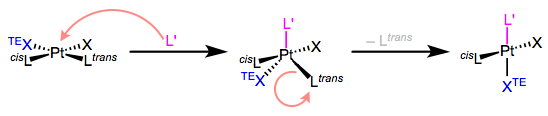
The mechanism of associative ligand substitution of Pt(II) complexes.

Some very important points about this mechanism:
  • The incoming ligand always sits at an equatorial site in the trigonal bipyramidal intermediate. More on this another day, but I think of this result as governed by the principle of least motion. Consider the molecular gymnastics that would have to happen to place the incoming ligand in an axial position.
  • Two ligands in the square plane are “pushed down” and become the other two equatorial ligands.
  • Owing to microscopic reversibility, the leaving group must be one of the equatorial ligands.
The third point tells that once L’ has “pushed down” XTE and Ltrans, Ltrans has no choice but to leave. Thus, the trans effect has nothing to do with the second step of the mechanism, thus it is not thr rate determining step. The main thing is in the first step, the “pushing down” event. Apparently, ligands with strong trans effects like to be pushed down. They like to occupy the equatorial plane of the Trigonal Bipyramidal (TBP) intermediate. The reason is: the equatorial sites of the TBP geometry are more Ï€ basic than the axial sites. The equatorial plane is just the xy-plane of the metal center, and the d orbitals in that plane (when occupied) are great electron sources for Ï€-acidic ligands. Thus, Ï€-acidic ligands want to occupy those equatorial sites, to receive the benefits of strong backbonding! Hence; strong Ï€-acids encourage loss of the ligand trans to themselves.
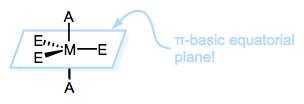
The equatorial sites of TBP metals are rich in electrons that can π bond.

Why the trans substitution is favored?

In the 5-coordinate Trigonal bipyramidal  transition state, the electrostatic repulsion is decreased due to removal of electron density in the equatorial plane. The removal of electron density is facilitated by the Ï€-interaction of the trans directing ligand, T as shown below.

NOTE: The square planar substitution reactions occur slowly due to loss of CFSE during the formation of trigonal bipyramidal complex from square planar one. The loss of CFSE is increased down the group. Hence the square planar substitutions of 4d and 5d series are slower. This is why most of the square planar substitution kinetic studies are done on Pt(II) complexes.


Example of Trans Effect

The Trans effect can dictate the product formed in the substitution reactions. The classic example of Trans effect is the synthesis of cis-platin, cis-diamminedichloridoplatinum(II). It is prepared by substituting the two chloro groups of PtCl42- by ammonia molecules. 
In the first step, any of the chloro group is substituted by ammonia randomly. But in the second step, the ammonia group preferentially substitutes the chloro group cis to the first ammonia. This can be attributed to the fact that the Cl- has a larger trans effect than NH3.

Whereas, the trans product is obtained by starting from Pt(NH3)42+. In this case the second Cl group is substituted preferentially at trans position to the first one.


Liked The Post...??? Don't Forget to Share with your friends.


Like Our Facebook Page to get Notified with Updated Posts:

www.facebook.com/chemohollic

AND

https://www.youtube.com/channel/UCD9sjzPA93mxDmbL25qYLow?sub_confirmation=1

Read More

Wednesday, October 25

Noorul Huda

CSIR Results Delayed- Know WHY ??

We were getting frequent messages, mails, comments from our readers. All were asking just one question, "when will this CSIR Result will publish ?". We as per our past experience and pattern of CSIR Exams and Form Filling, just predicted it to be published in the month of October.


But now it is last week of October and there is no sign of result still on the CSIR HRDG website. The question still remained unanswered that why results are delayed?

Today on 25th October The Deputy Secretary of Examination has published a Notice on CSIR official website in which he has answered the above question and asked us to bear with them.
The Notice states that
"The declaration of result of Joint CSIR-UGC JRF/NET June-2017 examination held on 18/06/2017 is delayed because of legal issues involved in the wake of the Judgement of Hon'ble High court of Punjab and Haryana in CWP 8015/2017 dated 28/09/2017."
  
Further he asked all the candidates who appeared in exam to stay calm and told that:
 "The result will be declared in the due course of time. We request all the candidates who had appeared in the above examination to kindly bear with us."


Here's the official link for the Notification- Click Here

 
There are few questions which come across our minds that Why can’t India’s most prominent scientific organization solve this persistent problem of Delayed Results.
Here are a few view points which we received from our readers and can’t be ignored:
  • Taking CSIR NET Exams Online: When GATE & CAT can go online why can’t CSIR ? This will not just save tonnes of paper which is used in the exam but also fasten the result declaration process. Greener Exam, Faster Results
  • Have a prior Result declaration Date: GATE has it, then why can’t CSIR ? If we have a prior result declaration date then certainly students can plan their career better. 

What are your views ? Comment below and let us know what you think about this.

Like Our Facebook Page to get Notified with Updated Posts:

www.facebook.com/chemohollic

AND
https://www.youtube.com/channel/UCD9sjzPA93mxDmbL25qYLow?sub_confirmation=1
Read More

Tuesday, October 24

Noorul Huda

Jahn Tellar Distortion/Theorem/Effect/Problems

The Jahn-Teller effect explains why certain 6 coordinated complexes undergo distortion to assume distorted octahedral (tetragonal) geometry. "This is a geometric distortion of a non-linear molecular system that reduces its symmetry and energy". This distortion is typically observed among octahedral complexes where the two axial bonds can be shorter or longer than those of the equatorial bonds. This effect can also be observed in tetrahedral compounds. This effect is dependent on the electronic state of the system.

Introduction

In 1937, Hermann Jahn and Edward Teller postulated a theorem stating that "stability and degeneracy are not possible simultaneously unless the molecule is a linear one," in regards to its electronic state.This leads to a break in degeneracy which stabilizes the molecule and by consequence, reduces its symmetry. Since 1937, the theorem has been revised which House-croft and Sharpe have eloquently phrased as "any non-linear molecular system in a degenerate electronic state will be unstable and will undergo distortion to form a system of lower symmetry and lower energy, thereby removing the degeneracy." This is most commonly observed with transition metal octahedral complexes, however, it can be observed in tetrahedral compounds as well.

For a given octahedral complex, the five d atomic orbitals are split into two degenerate sets when constructing a molecular orbital diagram. These are represented by the sets' symmetry labels: t2g (dxz, dyz, dxy) and eg (dz2 and dx2−y2). When a molecule possesses a degenerate electronic ground state, it will distort (Jahn-Teller effect) to remove the degeneracy and form a lower energy (and by consequence, lower symmetry) system. The octahedral complex will either elongate or compress the z ligand bonds as shown in Figure 1 below:


Elongated_v_Compressed.jpg
Figure 1: Jahn-Teller distortions for an octahedral complex.

When an octahedral complex exhibits elongation, the axial bonds are longer than the equatorial bonds. For a compression, it is the reverse; the equatorial bonds are longer than the axial bonds. Elongation and compression effects are dictated by the amount of overlap between the metal and ligand orbitals. Thus, this distortion varies greatly depending on the type of metal and ligands. In general, the stronger the metal-ligand orbital interactions are, the greater the chance for a Jahn-Teller effect to be observed.

Elongation (Z-Out distortion)

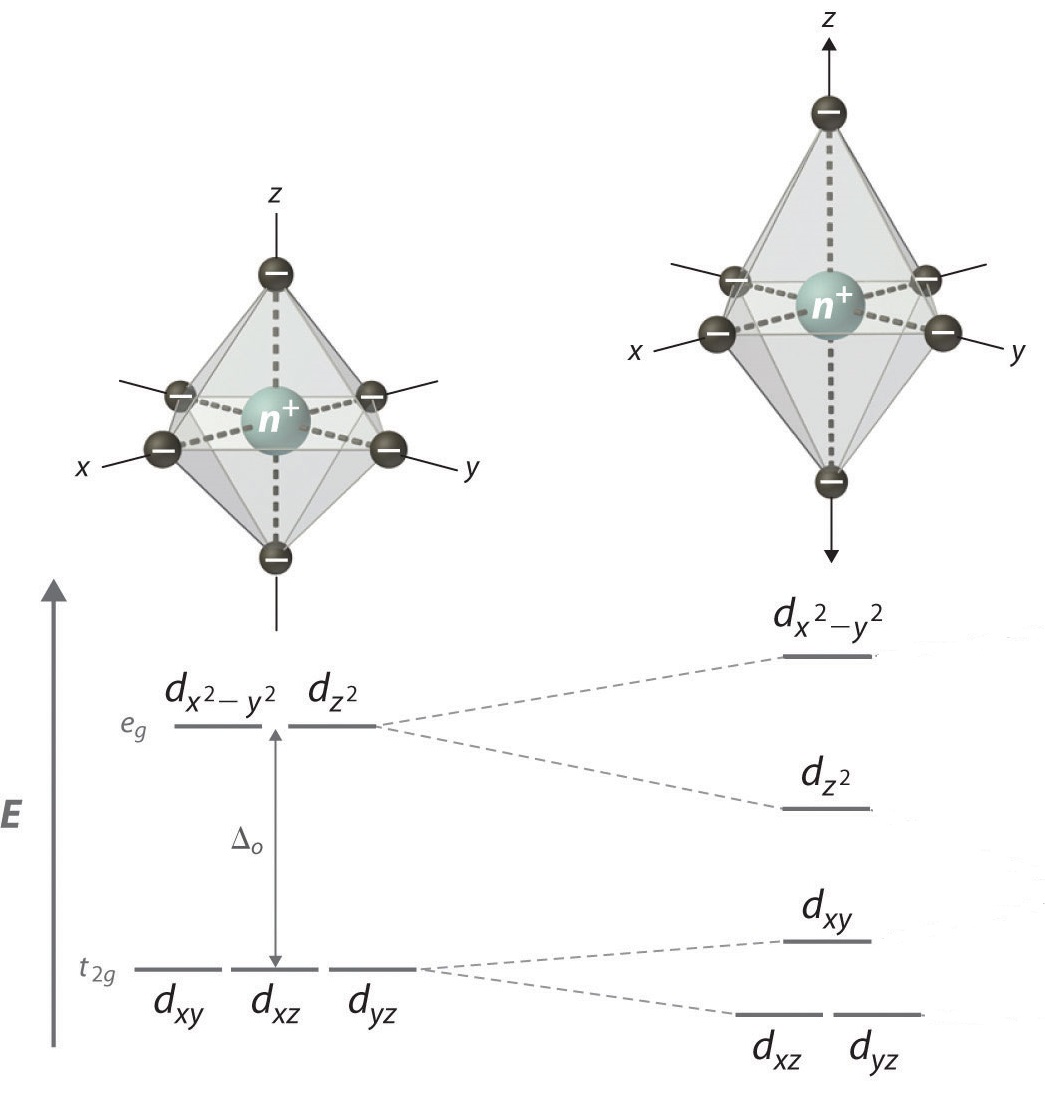
Elongation Jahn-Teller distortions occur when the degeneracy is broken by the stabilization (lowering in energy) of the d orbitals with a z component, while the orbitals without a z component are destabilized (higher in energy) as shown in Figure 2 below:
Figure 2: Illustration of tetragonal distortion (elongation) for an octahedral complex.

This is due to the dxy and dx2y2 orbitals having greater overlap with the ligand orbitals, resulting in the orbitals being higher in energy. Since the dx2y2orbital is antibonding, it is expected to increase in energy due to elongation. The dxy orbital is still nonbonding, but is destabilized due to the interactions. 
Jahn-Teller elongations are well-documented for copper(II) octahedral compounds. A classic example is that of copper(II) fluoride as shown in Figure 3.


copper(II)_fluoride.jpg
Figure 3: Structure of octahedral copper(II) fluoride.

Notice that the two axial bonds are both elongated and the four shorter equatorial bonds are the same length as each other. According the theorem, the orbital degeneracy is eliminated by distortion, making the molecule more stable based on the model presented in Figure 2.

Compression (Z-In distortion)

Compression Jahn-Teller distortions occur when the degeneracy is broken by the stabilization (lowering in energy) of the d orbitals without z component, while the orbitals with a z component are destabilized (higher in energy) as shown in Figure 4 below:
Compressed.jpg
Figure 4: Illustration of tetragonal distortion (compression) for an octahedral complex.

This is due to the z-component d orbitals having greater overlap with the ligand orbitals, resulting in the orbitals being higher in energy. Since the dz2 orbital is anti-bonding, it is expected to increase in energy due to compression. The dxz and dyz orbitals are still non-bonding, but are destabilized due to the interactions.

Electronic Configurations and JT Distortions:

For Jahn-Teller effects to occur in transition metals there must be degeneracy in either the t2g or eg orbitals. The electronic states of octahedral complexes are classified as either low spin or high spin. The spin of the system is dictated by the chemical environment. This includes the characteristics of the metal center and the types of ligands.


Distortions are more pronounced if the degeneracy occurs in an eg orbital

Low Spin

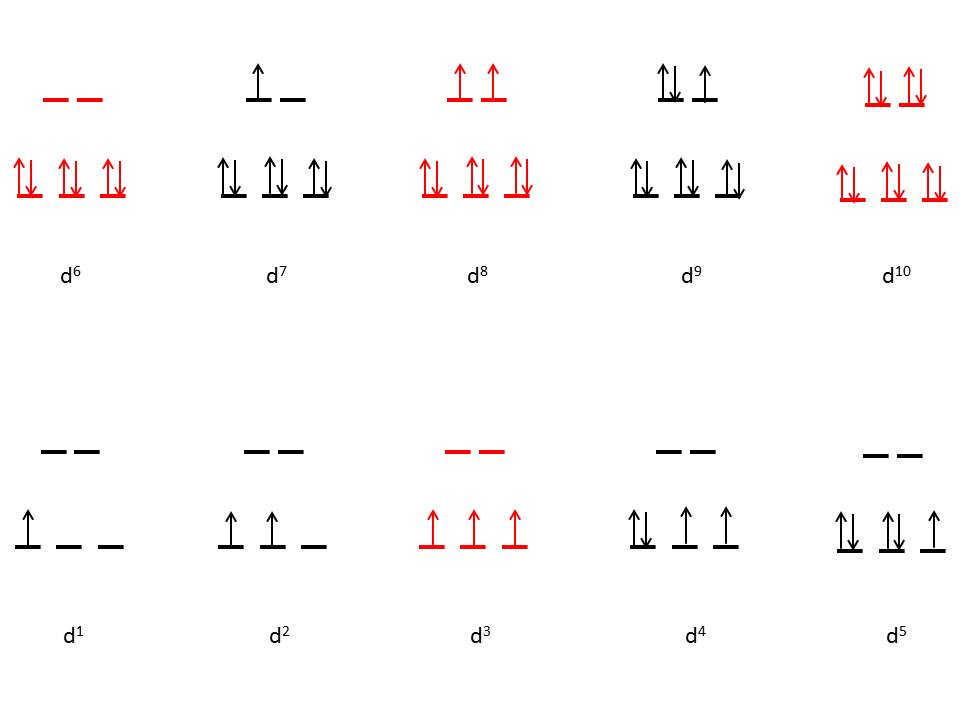
Figure 5 (below) shows the various electronic configurations for low spin octahedral complexes, The Red Colored electronic configurations does not show any distortions whereas the Black Colored electronic configurations does:
Low_Spin2.jpg
Figure 5: Low spin octahedral coordination diagram (red indicates no degeneracies possible, thus no Jahn-Teller effects).

The figure illustrates that low spin complexes with d3, d5, d8, and d10 electrons that do no exhibit Jahn-Teller distortions. These electronic configurations correspond to a variety of transition metals. Many common examples include Cr3+, Co3+, and Ni2+.

High Spin

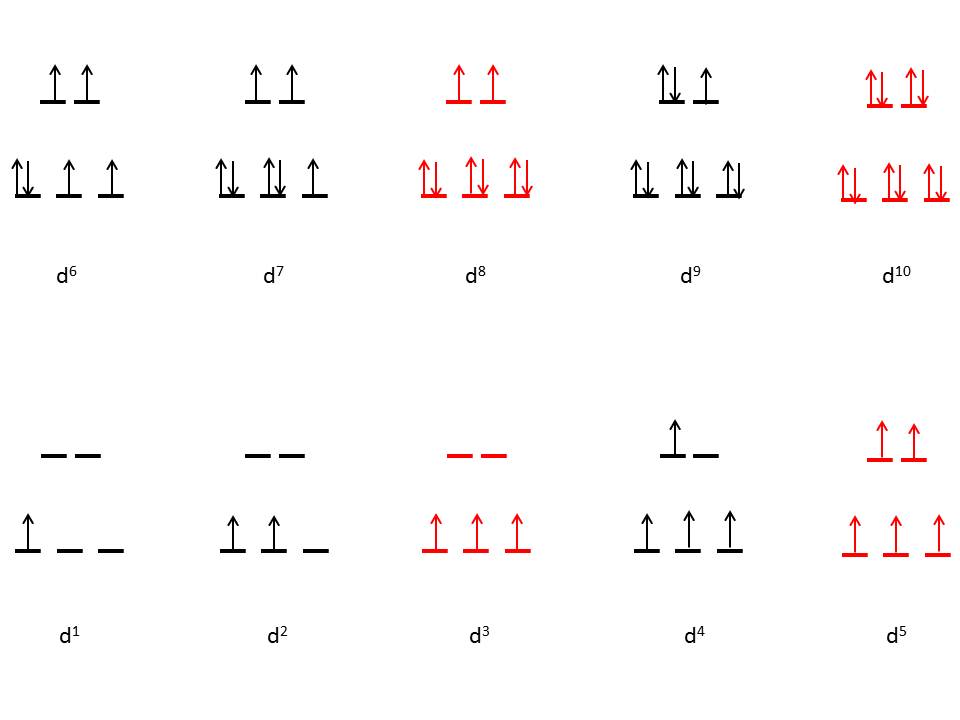
Figure 6 (below) shows the various electronic configurations for high spin octahedral complexes, The Red Colored electronic configurations does not show any distortions whereas the Black Colored electronic configurations does:
High_Spin2.jpg
Figure 6: High spin octahedral coordination diagram (red indicates no degeneracies possible, thus no Jahn-Teller effects)

The figure illustrates that low spin complexes with d3, d5, d8, and d10 electrons cannot have Jahn-Teller distortions. In general, degenerate electronic states occupying the eg orbital set tend to show stronger Jahn-Teller effects. This is primarily caused by the occupation of these high energy orbitals. Since the system is more stable with a lower energy configuration, the degeneracy of the eg set is broken, the symmetry is reduced, and occupations at lower energy orbitals occur.


Spectroscopic Effects of JT Distortion

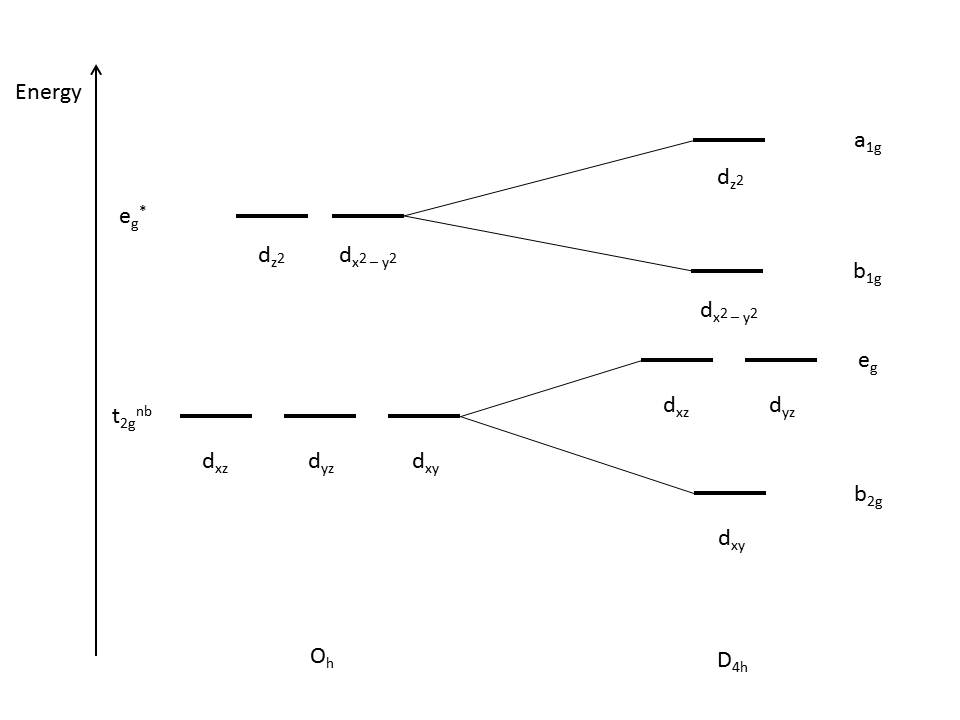
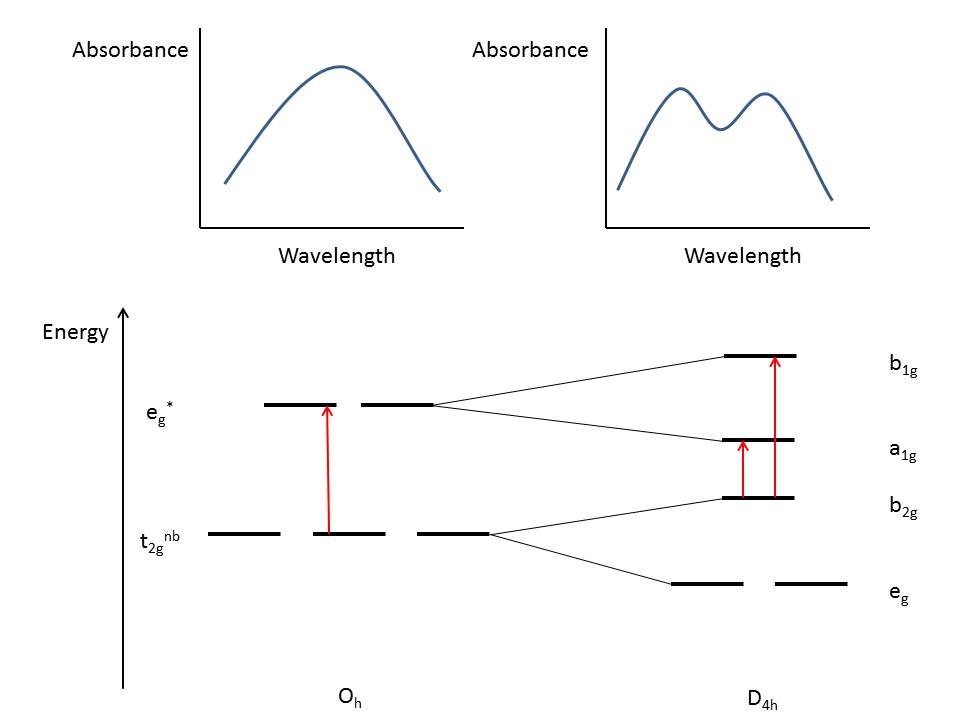
Jahn-Teller distortions can be observed using a variety of spectroscopic techniques. In UV-VIS absorption spectroscopy, distortion causes splitting of bands in the spectrum due to a reduction in symmetry (Oh to D4h). Consider a hypothetical molecule with octahedral symmetry showing a single absorption band. If the molecule were to undergo Jahn-Teller distortion, the number of bands would increase as shown in Figure 7 below:
Absorption.jpg
Figure 7: Hypothetical absorption spectra of an octahedral molecule (left) and the same molecule with Jahn-Teller elongation (right). The red arrows indicate electronic transitions.

A similar phenomenon can be seen with IR and Raman vibrational spectroscopy. The number of vibrational modes for a molecule can be calculated using the 3n - 6 rule (or 3n - 5 for linear geometry) rule. If a molecule exhibits an Oh symmetry point group, it will have fewer bands than that of a Jahn-Teller distorted molecule with D4h symmetry. Thus, one could observe Jahn-Teller effects through either IR or Raman techniques. This effect can also be observed in EPR experiments as long as there is at least one unpaired electron.
Table 1: Examples of Jahn-Teller distorted complexes
CuBr2 4 Br at 240 pm 2 Br at 318 pm
CuCl2 4 Cl at 230 pm 2 Cl at 295 pm
CuCl 2.2H 2O 2 O at 193 pm 2 Cl at 228 pm 2 Cl at 295 pm
CsCuCl3 4 Cl at 230 pm 2 Cl at 265 pm
CuF2 4 F at 193 pm 2 F at 227 pm
CuSO4.4NH3.H2O 4 N at 205 pm 1 O at 259 pm 1 O at 337 pm
K2CuF4 4 F at 191 pm 2 F at 237 pm
KCuAlF6 2 F at 188 pm 4 F at 220 pm
CrF2 4 F at 200 pm 2 F at 243 pm
KCrF3 4 F at 214 pm 2 F at 200 pm
MnF3 2 F at 209 pm 2 F at 191 pm 2 F at 179 pm


The Jahn-Teller Theorem predicts that distortions should occur for any degenerate state, including degeneracy of the t2g level, however distortions in bond lengths are much more distinctive when the degenerate electrons are in the eg level.

Summary

We can summarize all the above contents, the type of distortion and the strength of distortion for different type of complexes in the below table:

Change in geometry and arrangement of orbitals

Change in geometry and arrangement of orbitals in different Distortions


Consequences of JT Distortion

Jahn Tellar Distortion leads to some amazing consesquences, some of which are given below:

1. Stability of Cu2+ ion

As given by the Irwing-William Series, the relative stabilities of complexes in (+2) oxidation states of different metals is as follows:


Ba2+ < Sr2+ < Ca2+ < Mg2+ < Mn2+ < Fe2+ < Co2+ < Ni2+ < Cu2+ > Zn2+

The Cu2+ complexes are more stable than Zn2+ complexes due to the Jahn-Tellar distortion observed in Cu2+ complexes which is absent in the later.

2. Instability of Au2+ ion

Au2+ disproportionate into Au3+ and Au1+ because in Au2+ one electron is present in very high energy,  which easily gets removed.
Orbital Splitting in ion Au2+ion (The 9th electron is in very high energy state)

3. Instability of Chelating Complexes


[Cu(en)3]2+ is Not Stable. Why?


The above complex is a chelating complex of Cu2+ .This shows Jahn Tellar distortion. Cu-N bonds at axial positions try to elongate (due to JT Effect) but this elongation causes strain in the molecule. Hence the complex becomes unstable.

Practice Questions

  1. Why do d3 complexes not show Jahn-Teller distortions?
  2. Does the spin system (high spin v. low spin) of a molecule play a role in Jahn-Teller effects?
  3. What spectroscopic method would one utilize in order to observe Jahn-Teller distortions in a diamagnetic molecule?
  4. What spectroscopic method(s) would one utilize in order to observe Jahn-Teller distortions in a paramagnetic molecule?
  5. Why are Jahn-Teller effects most prevalent in inorganic (transition metal) compounds?

Answers

  1. Complexes with d3 electron configurations do not show Jahn-Teller distortions because there is no ground state degeneracy.
  2. Yes. Examining the d5 electron configuration, one finds that the high spin scenario contains all singly occupied d orbitals (no degeneracy). However, the low spin d5 electron configuration shows degeneracy, which then leads to possible Jahn-Teller effects.
  3. UV-VIS absorption spectroscopy is one of the most common techniques for observing these effects. In general, it is independent of magnetism (diamagnetic v. paramagnetic). Thus, one would see the effect in the spectrum of UV-VIS absorption analysis. Note that EPR requires at least one unpaired electron, and therefore not EPR active.
  4. Inorganic, specifically transition metal, complexes are most prevalent in showing Jahn-Teller distortions due to the availability of d orbitals. The most common geometry that the Jahn-Teller effect is observed is in octahedral complexes (see Figures 2, 4, 5 and 6 above) due to the splitting of d orbitals into two degenerate sets. Due to stabilization, the degeneracies are removed, making a lower symmetry and lower energy molecule.
  5. In addition to UV-VIS absorption, one can also employ EPR spectroscopy if a molecule possesses and unpaired electron.


References

  1. Jahn, H. A.; Teller, E. Proc. R. Soc. London A1937161, 220-235. DOI: 10.1098/rspa.1937.0142
  2. Housecroft, C.; Sharpe, A. G. Inorganic Chemistry. Prentice Hall, 3rd Ed., 2008, p. 644. ISBN: 978-0-13-175553-6
  3. Billy, C.; Haendler, H. A. J. Am. Chem. Soc.195779, 1049–1051. DOI: 10.1021/ja01562a011
  4. Chemistry Libretexts (https://chem.libretexts.org/)
  5. Wikipedia (https://en.wikipedia.org/wiki/Main_Page)
  6. Google (for images)


Liked The Post...??? Don't Forget to Share with your friends.

Like Our Facebook Page to get Notified with Updated Posts:

www.facebook.com/chemohollic

AND

https://www.youtube.com/channel/UCD9sjzPA93mxDmbL25qYLow?sub_confirmation=1


Read More