Tuesday, May 31

Noorul Huda

Chemical Compositions

Mixture or "pure substance" ?


In science it is necessary to know exactly what we are talking about, so before we can even begin to consider matter from a chemical point of view, we need to know something about its composition; is the stuff I am looking at a single substance, or is it a mixture? (We will get into the details of the definitions elsewhere, but for the moment you probably already have a fair understanding of the distinction; think of a sample of crystalline salt (sodium chloride) as opposed to a solution of salt in water— a mixture of salt and water.)
Jar of peanut butter
To a chemist, there is a fundamental distinction between a pure substance and a mixture.
But marketers, and through them, the general public, don't hesitate to describe a complex mixture such as peanut butter as "pure".  Pure what?


Elements and compounds
It has been known for at least a thousand years that some substances can be broken down by heating or chemical treatment into "simpler" ones, but there is always a limit; we eventually get substances known as elements that cannot be reduced to any simpler forms by ordinary chemical or physical means. What is our criterion for "simpler"? The most observable (and therefore macroscopic) property is the weight.
The idea of a minimal unit of chemical identity that we call an element developed from experimental observations of the relative weights of substances involved in chemical reactions. For example, the compound mercuric oxide can be broken down by heating into two other substances:
2 HgO → 2 Hg + O2
... but the two products, metallic mercury and dioxygen, cannot be decomposed into simpler substances, so they must be elements.
The definition of an element given above is an operational one; a certain result (or in this case, a non-result!) of a procedure that might lead to the decomposition of a substance into lighter units will tentatively place that substance in one of the categories, element or compound. Because this operation is carried out on bulk matter, the concept of the element is also a macroscopic one.

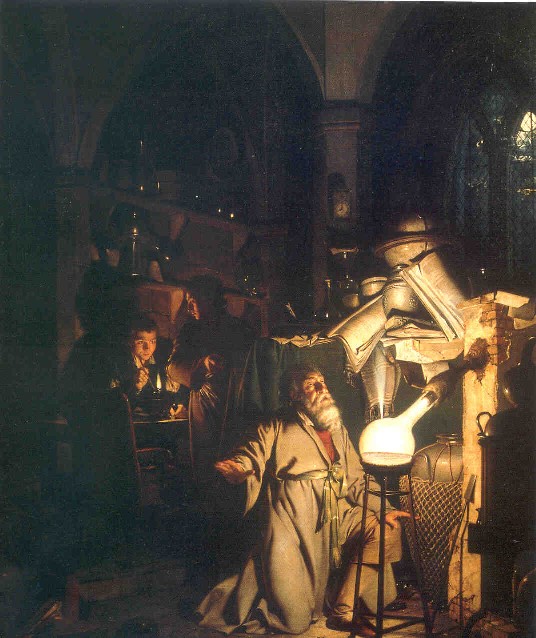
Painting by Joseph Wright of Derby (1734-97) The Alchymist in Search of the Philosopher's Stone discovers Phosphorus


Elements and atoms

The atom, by contrast, is a microscopic concept which in modern chemistry relates the unique character of every chemical element to an actual physical particle. The idea of the atom as the smallest particle of matter had its origins in Greek philosophy around 400 BCE but was controversial from the start (both Plato and Aristotle maintained that matter was infinitely divisible.) It was not until 1803 that John Dalton proposed a rational atomic theory to explain the facts of chemical combination as they were then known, thus being the first to employ macroscopic evidence to illuminate the microscopic world.
It took almost until 1900 for the atomic theory to became universally accepted. In the 1920's it became possible to measure the sizes and masses of atoms, and in the 1970's techniques were developed that produced images of individual atoms.
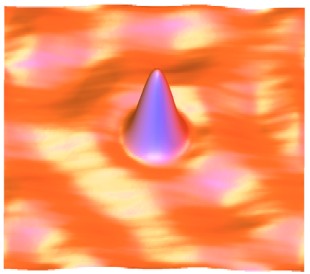
← Cobalt atom imaged by a scanning tunneling microscope


Formula and structure

The formula of a substance expresses the relative number of atoms of each element it contains. Because the formula can be determined by experiments on bulk matter, it is a macroscopic concept even though it is expressed in terms of atoms. What the ordinary chemical formula does not tell us is the order in which the component atoms are connected, whether they are grouped into discrete units (molecules) or are two- or three dimensional extended structures, as is the case with solids such as ordinary salt. The microscopic aspect of composition is structure, which in its greatest detail reveals the relative locations (in two or three dimensional space) of each atom within the minimum collection needed to define the structure of the substance.

Macroscopic

Microscopic

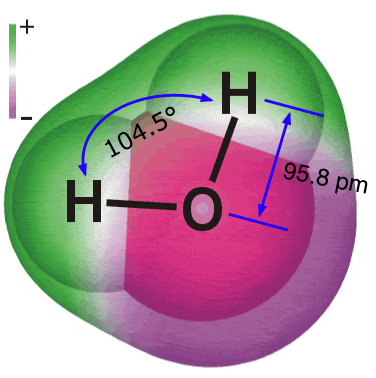
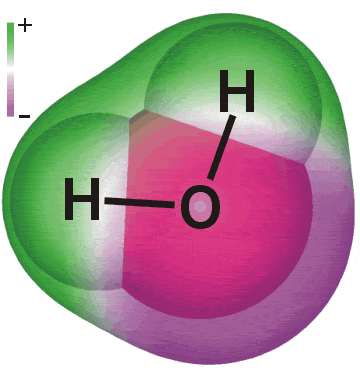
Substances are defined at the macroscopic level by their formulas or compositions, and at the microscopic level by their structures. The elements hydrogen and oxygen combine to form a compound whose composition is expressed by the formula H2O.
The molecule of water has the structure shown here.
Chemical substances that cannot be broken down into simpler ones are known as elements. The actual physical particles of which elements are composed are atoms or molecules.
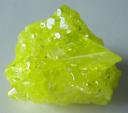
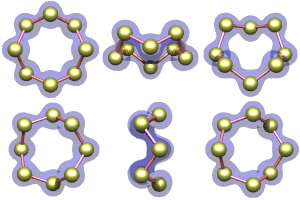
Sulfur-the-element in its orthorhombic crystalline form.

The S8 molecule is an octagonal ring of sulfur atoms. The crystal shown at the left is composed of an ordered array of these molecules.
(This animation does not properly represent the actual vibrational motions of the molecule.)

Compounds and molecules

As we indicated above, a compound is a substance containing more than one element. Since the concept of an element is macroscopic and the distinction between elements and compounds was recognized long before the existence of physical atoms was accepted, the concept of a compound must also be a macroscopic one that makes no assumptions about the nature of the ultimate .
Thus when carbon burns in the presence of oxygen, the product carbon dioxide can be shown by (macroscopic) weight measurements to contain both of the original elements:
C + O2 → CO2
10.0 g + 26.7 g = 36.7 g
One of the important characteristics of a compound is that the proportions by weight of each element in a given compound are constant. For example, no matter what weight of carbon dioxide we have, the percentage of carbon it contains is (10.0 / 36.7) = 0.27, or 27%.

Molecules

A molecule is an assembly of atoms having a fixed composition, structure, and distinctive, measurable properties.
In its most general meaning, the term molecule can describe any kind of particle (even a single atom) having a unique chemical identity. Even at the end of the 19th century, when compounds and their formulas had long been in use, some prominent chemists doubted that molecules (or atoms) were any more than a convenient model.
Computer model of the nicotine molecule, C10H14N2, by Ronald Perry ↑

Molecules suddenly became real in 1905, when Albert Einstein showed that Brownian motion, the irregular microscopic movements of tiny pollen grains floating in water, could be directly attributed to collisions with molecule-sized particles.
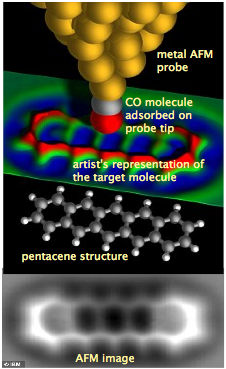
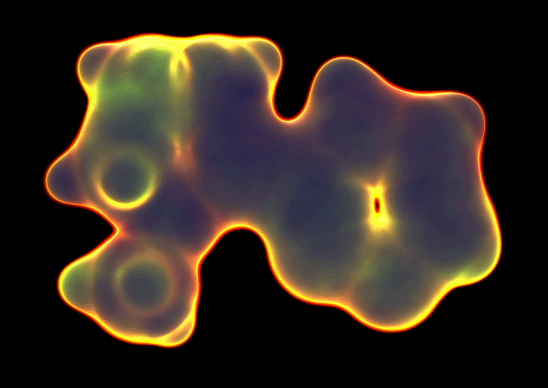
Finally, we get to see one! In 2009, IBM scientists in Switzerland succeeded in imaging a real molecule, using a technique known as atomic force microscopy in which an atoms-thin metallic probe is drawn ever-so-slightly above the surface of an immobilized pentacene molecule cooled to nearly absolute zero. In order to improve the image quality, a molecule of carbon monoxide was placed on the end of the probe.

The image produced by the AFM probe is shown at the very bottom. What is actually being imaged is the surface of the electron clouds of the molecule, which consists of six hexagonal rings of carbon atoms with hydrogens on its periphery. The tiny bumps that correspond to these hydrogen atom attest to the remarkable resolution of this experiment. The original article was publshed in Science magazine; see here for an understandable account of this historic work.


The atomic composition of a molecule is given by its formula. Thus the formulas CO, CH4, and O2 represent the molecules carbon monoxide, methane, and dioxygen. However, the fact that we can write a formula for a compound does not imply the existence of molecules having that composition. Gases and most liquids consist of molecules, but many solids exist as extended lattices of atoms or ions (electrically charged atoms or molecules.) For example, there is no such thing as a "molecule" of ordinary salt, NaCl (see below.)

Confused about the distinction between molecules and compounds?

Maybe the following will help:
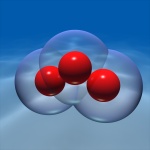


A molecule but not a compound - Ozone, O3, is not a compound because it contains only a single element.

This well-known molecule is a compound because it contains more than one element. [link]

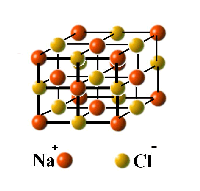
Ordinary solid salt is a compound but not a molecule. It is built from interpenetrating lattices of sodium and chloride ions that extend indefinitely.
Read More
Noorul Huda

The Scope of Chemical Science

Chemistry is too universal and dynamically-changing a subject to be confined to a fixed definition; it might be better to think of chemistry more as a point of view that places its major focus on the structure and properties of substances— particular kinds of matter— and especially on the changes that they undergo.
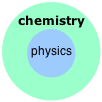
In some ways, physics might be considered more "fundamental" to the extent that it deals with matter and energy in a more general way, without the emphasis on particular substances. But the distincion can get pretty fuzzy; it is ultimately rather futile to confine any aspect of human endeavour to little boxes.

Chemistry: the central science

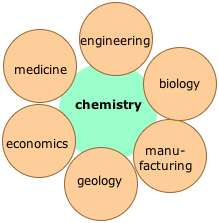
Chemistry: the central scienceThe real importance of Chemistry is that it serves as the interface to practically all of the other sciences, as well as to many other areas of human endeavor. For this reason, Chemistry is often said (at least by chemists!) to be the "central science".
Chemistry can be "central" in a much more personal way: with a solid background in Chemistry, you will find it far easier to migrate into other fields as your interests develop.

Chemistry can enhance any career. Chemistry is so deeply ingrained into so many areas of business, government, and environmental management that some background in the subject can be useful (and able to give you a career edge as a team member having special skills) in fields as varied as product development, marketing, management, computer science, technical writing, and even law.

So just what is chemistry?

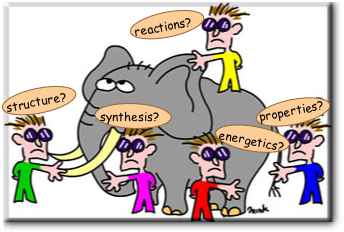
Do you remember the story about the group of blind men who encountered an elephant? Each one moved his hands over a different part of the elephant's body— the trunk, an ear, or a leg— and came up with an entirely different description of the beast.
Chemistry can similarly be approached in different ways, each yielding a different, valid, (and yet hopelessly incomplete) view of the subject.
Thus we can view chemistry from multiple standpoints ranging from the theoretical to the eminently practical:

Mainly theoretical

Mainly practical

Why do particular combinations of atoms hold together, but not others? What are the properties of a certain compound?
How can I predict the shape of a molecule? How can I prepare a certain compound?
Why are some reactions slow, while others occur rapidly? Does a certain reaction proceed to completion?
Is a certain reaction possible? How can I determine the composition of an unknown substance?

Boiling it down to the basics

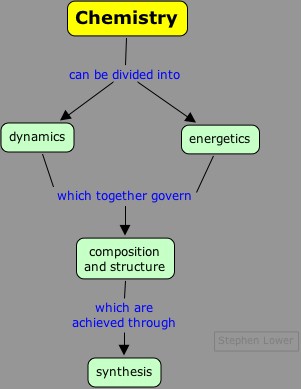
Chemistry concept mapAt the most fundmental level, chemistry can be organized along the lines shown here.

Dynamics
refers to the details of that rearrangements of atoms that occur during chemical change, and that strongly affect the rate at which change occurs.
Energetics
refers to the thermodynamics of chemical change, relating to the uptake or release of heat. More importantly, this aspect of chemistry controls the direction in which change occurs, and the mixture of substances that results.
Composition and structure
define the substances that are results of chemical change. Structure refers specifically to the relative arrangements of the atoms in space. The extent to which a given structure can persist is itself determined by energetics and dynamics.
 
Synthesis
strictly speaking, refers to formation of new (and usually more complex) substances from simpler ones, but in the present context we use it in the more general sense to denote the operations required to bring about chemical change and to isolate the desired products.
This view of Chemistry is a rather astringent one that is probably more appreciated by people who already know the subject than by those who are about to learn it, so we will use a somewhat expanded scheme to organize the fundamental concepts of chemical science. But if you need a single-sentence"definition of Chemistry, this one wraps it up pretty well:
Chemistry is the study of substances; their properties, structure, and the changes they undergo.
 

Micro-macro: the forest or the trees

Chemistry, like all the natural sciences, begins with the direct observation of nature— in this case, of matter. But when we look at matter in bulk, we see only the "forest", not the "trees"— the atoms and molecules of which matter is composed— whose properties ultimately determine the nature and behavior of the matter we are looking at.
This dichotomy between what we can and cannot directly see constitutes two contrasting views which run through all of chemistry, which we call macroscopic and microscopic.
  • In the context of Chemistry, "microscopic" implies detail at the atomic or subatomic levels which cannot be seen directly (even with a microscope!)

  • The macroscopic world is the one we can know by direct observations of physical properties such as mass, volume, etc.
The following table provides a conceptual overview of Chemical science according to the macroscopic/microscopic dichotomy we have been discussing. It is of course only one of many ways of looking at the subject, but you may find it a helpful means of organizing the many facts and ideas you will encounter in your study of Chemistry. We will organize the discussion in this lesson along similar lines.
realm macroscopic view microscopic view
composition formulas, mixtures structures of solids, molecules, and atoms
properties intensive properties of bulk matter particle sizes, masses and interactions
change (energetics) energetics and equilibrium statistics of energy distribution
change (dynamics) kinetics (rates of reactions) mechanistics
 
Read More
Noorul Huda

Chemistry

Chemistry is such a broad subject and one so full of detail that it is easy for a newcomer to find it somewhat overwhelming, if not intimidating. The best way around this is to look at Chemistry from a variety of viewpoints:
  • How Chemistry relates to other sciences and to the world in general
  • What are some of the fundamental concepts that extend throughout Chemistry?
  • What are some of the major currents of modern-day Chemistry?
Read More